submitted September 1999

Warning: Eclipse Chasing Can Be Hazardous to Your Health!

by Tom Naber, Cisco, IL

On August 5, 1999, I left the U.S. on a 13-day eclipse adventure to Turkey. I was on a tour arranged by Turkish Travel Specialists of Vancouver, B.C. for the Royal Astronomical Society of Canada. I was drawn to Turkey by the 85% chance of clear skies at eclipse time, much better prospects than any European location along the eclipse path. Our tour group took in a number of interesting and beautiful sights during the days leading up to the August 11 eclipse. There is an incredible amount of history in Turkey, with all of its ancient buildings, ruins, and other sites of archeological interest. Parts of what is now Turkey have been inhabited by civilized peoples for nearly 10,000 years.

Our chosen eclipse viewing site was in southeastern Turkey, in the midst of an ancient ruin at Hasankeyf. The nearest cities of any size to the site are Diyarbakir and Batman. We were deep in Kurdish territory, only about 40 miles from Syria and about 45 miles from Iraq. Some of us on the tour had at least a slight concern over our safety, since there had been threats several months ago by the Kurdish rebels to kill tourists, and we were to view the eclipse "right in their back yard." Because of the Web pages advertising our tour, any terrorist could easily find out exactly when and where we would be viewing the eclipse. Little did we realize that it would be a natural disaster that would threaten us on this trip, not a man-made one. The Turkish people we met on our trip were incredibly friendly and welcoming, especially in the southeastern part of the country which rarely sees tourists. No one ever threatened us in any manner on the entire trip.

It was blazing hot on eclipse day. Several folks in our group were monitoring temperatures to see how much they would drop off during the eclipse. Depending on whose thermometer you believed, it was somewhere between 114 and 118 degrees Fahrenheit in the shade at the start of the eclipse! It dropped to a cool 97 degrees during totality. Our eclipse site was on the top of a hill. To reach the site required a nearly vertical climb of about 600 feet. Due to confusion over the delivery of our equipment (cameras, tripods, etc.) to the eclipse site, some of us had to climb the hill twice in the heat, and nearly suffered heat stroke in the process. There was a heavy military presence throughout southeastern Turkey. Our eclipse viewing site featured roaming Turkish soldiers with machine guns. Our group did not have exclusive use of the site - hundreds of folks who live near the site joined us. We had fun showing them the sun through telescopes and binoculars, but we had to shoo them away as totality approached so we could observe and do our photographic work without interference.

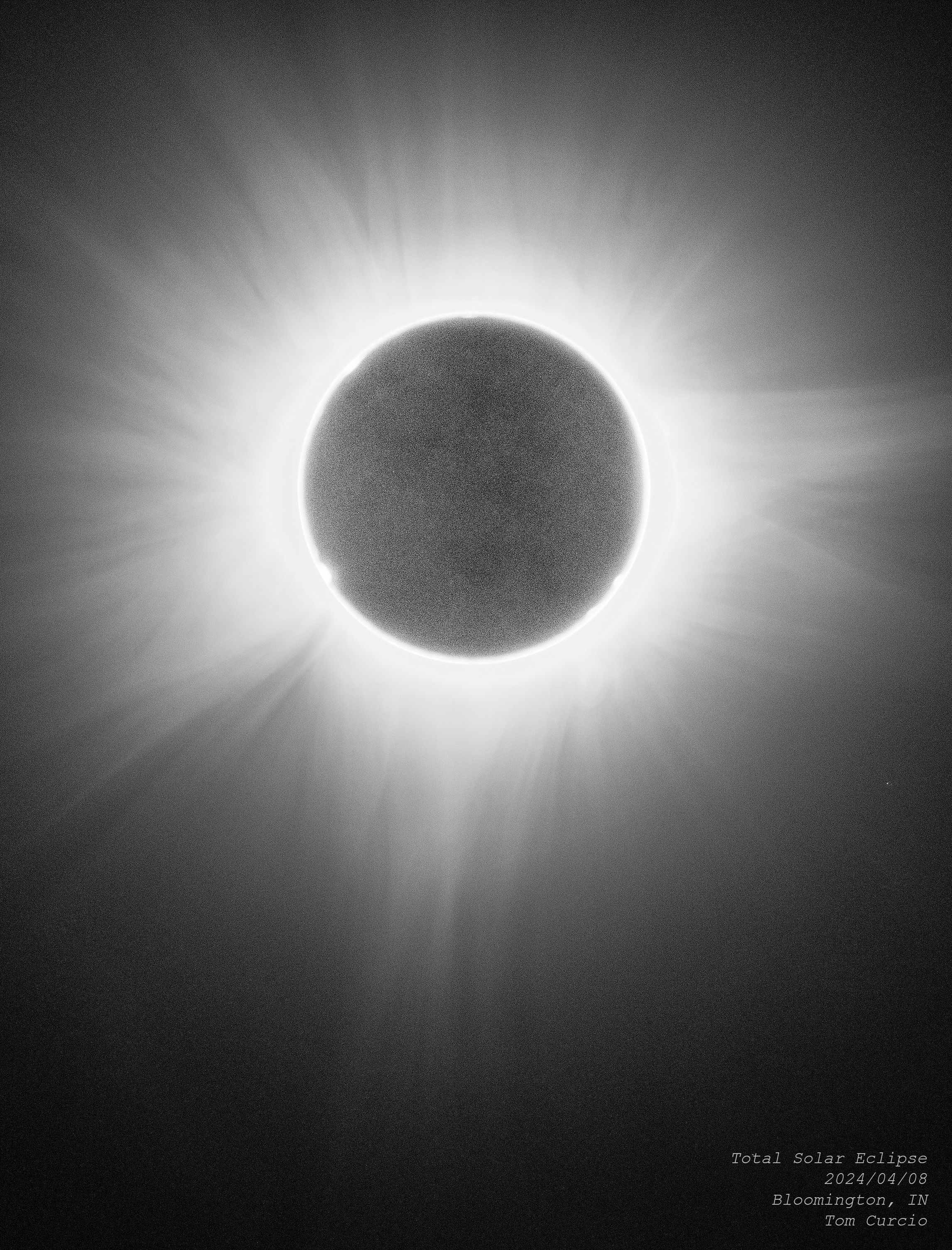
The eclipse itself was spectacular, with not a cloud in the sky to interfere. I found the prominences to be particularly nice this time. The corona did not seem to extend as far out from the sun as it has in other eclipses I have seen, but it was the most richly detailed corona I have seen. The coronal structure was complex and it contained some non-radial features. Many folks reported very distinct and easy-to-see shadow bands, but I never saw them, as my eyes were always directed skyward. As with any total eclipse of the sun, totality was much too short. I spent the first half of totality behind my cameras, and simply enjoyed the other half with my eyes. I vow to take absolutely no photographic equipment to the next eclipse, so I can fully enjoy it! I haven't had my film from the eclipse developed yet, but I wouldn't be surprised if it were ruined by the extreme heat. Following the eclipse, we went for a dip in the nearby Tigris River.

After the eclipse, we visited other parts of Turkey, including Mt. Nemrut, a site of astronomical importance. Here, high atop a mountain, a king built a monument to himself (he thought of himself as a god), which included gigantic statues of himself and several gods (like Zeus). The site was built to commemorate a spectacular conjunction of planets and the moon in Leo on July 7 62 BC. Apparently the big-headed king saw this event as a sign from the heavens that he was, in fact, divine. There is a large stone tablet carved with a lion and the stars of Leo, and a representation of the moon and planets in conjunction, all in approximately the relative locations they would have appeared in the sky.

Our tour group proceeded to Istanbul, where we stayed overnight before our flights home on August 17. I was sound asleep in my hotel room in Istanbul, when, at 3:02 AM, I was suddenly awakened by being nearly thrown out of my bed. The floor was heaving up and down violently. It felt like being on an airplane when it encounters severe turbulence. Within a few seconds, I was awake enough to realize that it was an earthquake and that I needed to get outside before the building collapsed on me. The electric power went out so it was totally dark. I started to run down the hall and realized I was only wearing my underwear, so I went back to the room and found my pants. I then thought that if I were killed, they wouldn't be able to identify my body, so I found my wallet and passport. By the time I was actually ready to leave, the shaking was subsiding and it was apparent that the ceiling was not going to come down. I laid in bed awake the rest of the night, enjoying the aftershocks that occurred about every 15 minutes. I was fortunate to have stayed in a hotel in the old part of the city. The buildings in this part of the city are centuries old and have withstood the test of time in this earthquake-prone region. Much of the death and destruction occurred in newer parts of the city containing younger, and often poorly constructed, buildings.

On our trip to the airport in the morning, it was apparent that something strange had happened. Power was apparently out in the entire city, so no traffic lights were working. Parks and other open areas were filled with thousands of people sleeping, sitting, or standing outside, for fear of going back into their homes. The airport suffered no major damage, so we were able to fly back to the U.S. with no major problems. It was only when I returned to the U.S. that I found out about the magnitude of the disaster. Had I known how bad it was, I would have stayed in Turkey several more days to assist in the recovery efforts. I hope and pray that the Turkish people can recover from this disaster and rebuild and put their lives back together as soon as possible.

I hope to return to Turkey in 2006 to see another total solar eclipse. I look forward to sharing some slides and/or video of the eclipse with CUAS at a future meeting.