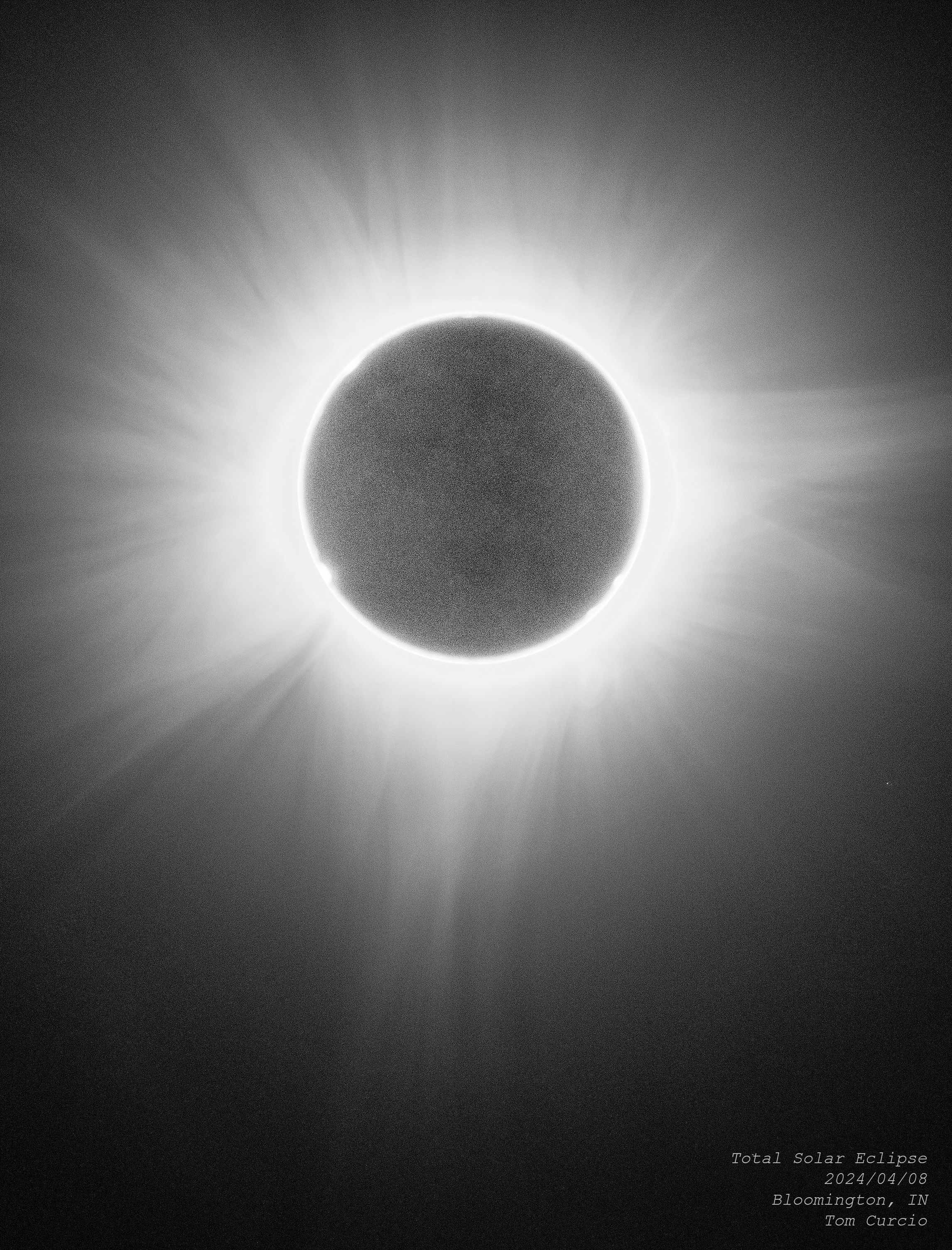
Happy New Year! It’s time to check out yet another year of skywatching. We will officially have six eclipses this year, four solar and two lunar. All four solars are partial and both lunars are total. And, as you might expect, we will only be able to see one . . .that being the total lunar eclipse on December 10. And the Moon will be setting during the eclipse, which begins at 8:06am. Australia, China and Japan are favored.
As far as the planets go, recall the outer planets are best seen when they are at “opposition,“ or opposite the Sun. This means they rise at sunset and set at sunrise and are closest to the Earth. That also means they look large in a telescope. This year, Saturn reaches opposition first on April 3, so it will be a nice late spring and summer object. Then comes Neptune on August 22, Uranus on September 25, and then Jupiter on October 28. Mars has opposition dates every 26 months and the last one was this past January. That means the next one will be in March, 2012. Now how much do you want to bet right now that we once again see the email about Mars being close to the Earth in August? It’s getting old! Mars is in the morning sky for most of the year and won’t rise before midnight until mid-November.
Venus and Mercury never seem to stray far from the Sun, so you either see them before sunrise or just after sunset. Venus begins the year in the morning sky, rising at about 4am. Greatest separation from the Sun occurs on January 8. After this, the rise time gets later until Venus is rising in the morning twilight in May. Venus passes behind the Sun about August 9 and then slowly appears in the evening sky. Venus sets with the evening twilight into September when we’ll start looking for it in the southwest. By the end of the year, Venus is high in our evening sky, setting at 7:30pm, a full two hours after the end of twilight.
Mercury makes brief appearances in both the morning and evening sky but
some are better than others, depending on the angle of the ecliptic with
the horizon. Mercury begins the year (New Year’s morning) in the
morning sky, rising about 45 minutes before twilight begins. It passes
behind the Sun towards the end of February and then vaults into the
evening sky for a nice view just after mid-March. On March 15, Mercury
“misses“ Jupiter by two degrees then reaches its largest
separation from the Sun on the 22nd. In early April, it abruptly rushes
back into the morning sky for a not-so-good apparition, and then back for
a good evening view for the summer. It rises from the glare of the Sun
towards the end of June and is there until very early August. Greatest
sun separation is July 19th. Maybe the best morning view occurs between
roughly August 22 and September 19.
Besides the previously mentioned Mercury/Jupiter gathering in March, the only other good planet gathering is Mercury and Venus in the fall. They come to within two degrees on both November 1st an 12th. The planetary logjam occurs in the morning sky in the spring. Mercury is 1.4o from Venus on May 8. Three mornings later, Jupiter joins the pair, coming to within 0.6o. On May 21st, Mars adds to the fun, coming near Mercury and then Venus two days later.
Meteor showers are always fun to watch as long as the Moon is favorable. Bright moonlight spoils the fainter “shooting stars.“ The Moon is New for the January 3-4 Quandrantids (see the “Looking Up“ section). The major showers are towards the late summer and fall. The April 22 Lyrids occur four days after a full Moon - not good. The popular Perseids (August 11-12) happen two days before Full Moon, meaning that there will only be a short time after the Moon sets and before the Sun rises for prime viewing. The October 21st Orionids will have to contend with a Moon two days past last quarter as does the November 17th Leonids (day before third quarter). Even the Geminids (December 14th) occur about four days past a full Moon, meaning a waning gibbous Moon will blow out the sky. So, not a good year for meteor showers. This doesn’t mean you won’t see any, but conditions are not optimum.
As far as the club goes, the monthly meetings will continue to be on the second Thursday of the month at 7pm in the Staerkel Planetarium. We’ll continue to do two viewing sessions most months with the Saturday closest to the first quarter Moon being a public open house and the week before reserved for members-only dark sky times. If you want to plan ahead (and please do!) those dates are Feb. 12, Mar. 12, Apr. 9, May 7 (National Astronomy Day), June 4, July 9, Aug. 6, Sept. 3, Oct. 1, Oct. 29 (yes, two in October!), and then maybe Dec. 3. Note there is no open house in January. We have noticed that few come to the cold weather open houses, so why do them? We’ll decide on December 3 when we get closer to the date. Also, we already have a date at Middle Fork, that being April 2. It’s up to the club, but we can also schedule dates again at Middle Fork, Homer Lake, or maybe try to go back to Allerton. We also might throw in that the Staerkel Planetarium will host a major regional conference on October 19-22.
Keep in mind that this year is the “Year of the Solar System.“ The “year“ here is really a Martian year which is 687 days long. NASA hopes to raise public awareness on the current missions to explore our solar system from October, 2010 to August, 2012. So, we have a focus! Lets have a great year!
– Dave Leake
For a focus on the current month, read Looking Up This Month